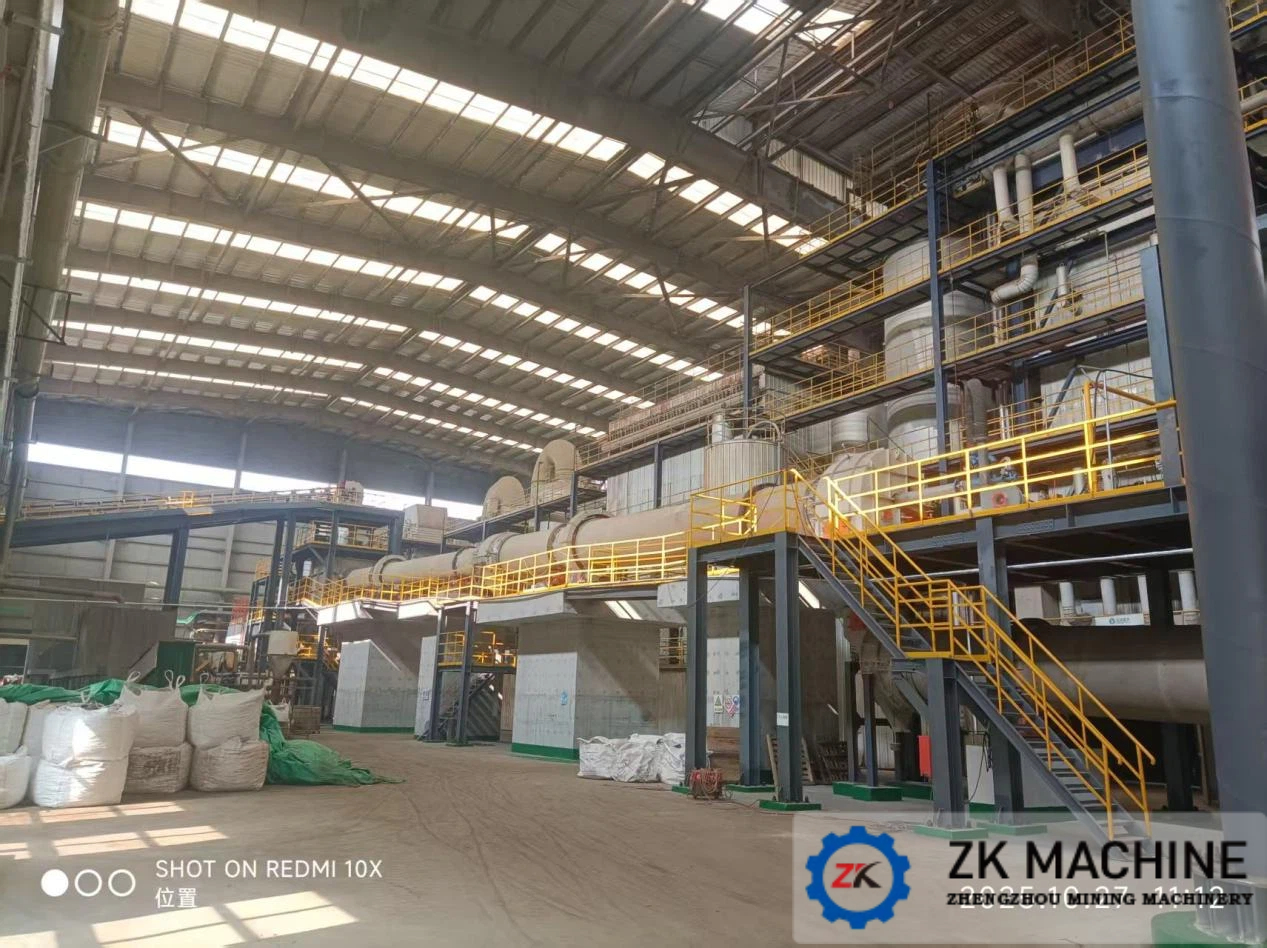
I. Project Overview
Location: Gucheng County, Hebei Province, China
Client: CNOOC Energy Conservation & Environmental Protection Services Co., Ltd.
Product Name: Oil Sludge Thermal Treatment & Conversion Plant Production Line
Service Scope: Turnkey technical services including process design, equipment supply, installation & commissioning, and after-sales training for:
- Feeding system
- Mixing & pelletizing system
- Drying, calcination, and cooling systems
- Finished product conveying system
- Environmental dust collection system
- Desulfurization & denitrification system
- Electrical automation control system
II. Project Description
CNOOC Energy Conservation & Environmental Protection Services Co., Ltd. constructed an oil sludge thermal treatment and conversion plant production line in Gucheng County, Hebei. The project adopts the method of converting drilling oil sludge into ceramsite to achieve the goals of volume reduction, harmless treatment, stabilization, and resource recovery.
III. Process Description
The production process is as follows:
Oil Sludge (in ton bags) → Pretreatment → Mixing → Pelletizing → Preheating → Calcination → Cooling → Finished Product.
3.1 Raw Material Pretreatment
After natural drying in the warehouse to partially evaporate moisture, the clay is processed through a stone remover and then sent for mixing.
3.2 Pelletizing
The mixed material is reclaimed by a stacker-reclaimer and fed into a feeder. The feeder delivers the material to a twin-shaft mixer. After mixing, the material achieves a moisture content of 15–25% and is then sent to a pelletizer. The resulting green pellets are conveyed via a steep-angle belt conveyor to the feed chute at the top of the kiln tail chamber and enter the rotary kiln.
3.3 Preheating, Calcination & Cooling
The green pellets are quantitatively fed into the spliced-type rotary kiln by the kiln tail feeding device. The spliced kiln consists of a preheating section and a calcining section, each driven by independent variable-frequency speed controllers. All connection points are equipped with fish-scale seals to prevent gas and dust leakage through negative pressure and sealing.
Inside the rotary kiln, the pellets gradually move toward the kiln head as the kiln rotates, while high-temperature gases flow from the kiln head to the kiln tail. During movement, the pellets exchange heat with the hot gases (via conduction, convection, and radiation). Their temperature gradually rises, triggering physical and chemical changes: oxidation-reduction, dehydration, and carbonate decomposition. The generated gases cause rapid expansion of the pellets. At high temperatures, a liquid phase forms on the pellet surface, sealing internal pores to form ceramsite.
3.4 Cooling & Finished Product System
The calcined high-temperature ceramsite enters a single-drum cooler. Under the negative pressure from the kiln head, cold air is drawn in from the cooler discharge end. The ceramsite is cooled upon contact with the cold air, forming a glazed surface.
The cooled ceramsite is lifted by a bucket elevator to the finished product silo for subsequent transport.
IV. Major Equipment Supplied
| No. | Equipment | Model | Quantity |
| 1 | Drying Kiln | YM1220 | 1 set |
| 2 | Calcination Kiln | YM1618 | 1 set |
| 3 | Cooling Kiln | LJ1518 | 1 set |