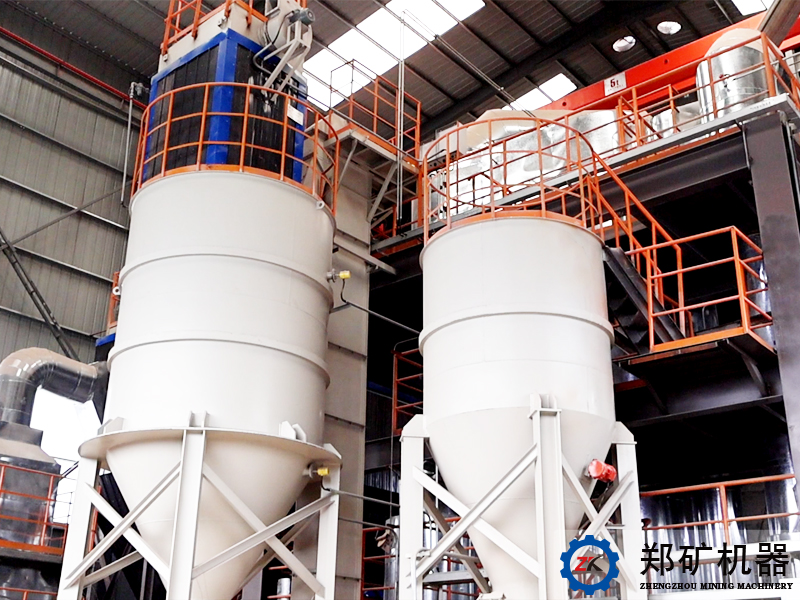
Suspension kiln calcination of dolomite is a highly efficient thermal decomposition technology based on the principle of gas-solid suspension heat exchange. By maintaining dolomite particles in a suspended state within a high-temperature gas stream, it achieves rapid and uniform calcination. Compared to traditional equipment like shaft kilns and rotary kilns, its advantages span five core dimensions: efficiency, quality, energy consumption, environmental friendliness, and adaptability. The specific benefits are detailed in the following six aspects, covering both common and differentiated advantages for raw materials of different particle sizes (e.g., conventional granules, 200-mesh fine powder):
1. Extremely High Heat and Mass Transfer Efficiency, Ensuring More Complete and Faster Calcination
The core advantage of the suspension kiln lies in maximizing the gas-solid contact area: the high-temperature gas flow (velocity 3-5 m/s) causes dolomite particles (whether conventional 0.1-3mm or 200-mesh fine powder) to be completely in a "dispersed suspended state." The gas-solid contact area increases by 10-20 times compared to traditional fixed/moving beds (e.g., shaft kilns), and the heat transfer coefficient can reach 100-150 W/(m²·K), which is 3-4 times that of traditional equipment.
For conventional 0.1-3mm particles: The calcination residence time is only 10-30 seconds (compared to 2-4 hours in traditional rotary kilns and 4-6 hours in shaft kilns). The stepwise decomposition of MgCO₃ (600-750°C) and CaCO₃ (800-950°C) is thorough, with product decomposition rate stably exceeding 95%.
For 200-mesh fine powder: The specific surface area is further enlarged (approx. 2.5-3.5 m²/g), the residence time can be shortened to 5-12 seconds, and the decomposition rate exceeds 98%, with virtually no "under-calcined" particles (under-calcination rates in traditional processes often reach 5%-10%).
2. Superior Product Quality: High Activity, High Purity, and Strong Stability
The core product of dolomite calcination is light-burned dolomite (CaO·MgO), whose quality directly determines its downstream application value (e.g., steel desulfurization, chemical preparation). The suspension kiln shows significant advantages in this dimension:
Significantly Enhanced Activity: Suspension calcination avoids the "over-burning on the outside, under-calcination on the inside" issue common in traditional processes. The generated CaO and MgO crystals are fine with numerous lattice defects, resulting in higher reactivity. The CaO activity of conventional granule products can reach 300-350 mL (4mol/L HCl titration method), and 200-mesh fine powder products can reach 380-450 mL, far exceeding shaft kiln products (250-300 mL). High activity means higher efficiency in downstream applications (e.g., steel desulfurization efficiency increases by 10%-15%, desulfurizer consumption decreases by 15%-20%).
Low Impurity Content: The pre-treatment stage in the suspension kiln (magnetic separation for iron removal, fine screening) allows precise impurity control, with SiO₂ content<1.5% and Fe₂O₃ <0.3%, avoiding impurity enrichment caused by uneven raw material mixing in traditional equipment (SiO₂ often exceeds 3% in traditional processes). Low impurities reduce downstream side reactions (e.g., preventing the formation of low-melting-point Ca₂SiO₄ during magnesium smelting, extending equipment life by 30%).
Strong Quality Stability:** Utilizing PLC + DCS fully automatic control systems, it monitors temperature (precision ±5°C), gas velocity, and feed rate in real-time. The product activity fluctuation range is<5% (conventional granules) and <3% (200-mesh fine powder), with particle size fluctuation within ±10 mesh, far superior to traditional processes (activity fluctuation ±8%, particle size fluctuation ±50 mesh).
3. Significantly Reduced Energy Consumption, Highlighting Energy Savings
The suspension kiln achieves much lower unit energy consumption than traditional equipment through "efficient waste heat recovery + maximized heat utilization," with fine powder raw materials further amplifying the energy-saving effect:
Adequate Waste Heat Recovery:** The kiln body adopts a three-stage "preheating - calcination - cooling" structure. The preheating stage uses calcination exhaust gas (800-900°C) to heat the raw materials, and the cooling stage uses product waste heat to heat the combustion air (cold air can be heated from ambient temperature to 250-400°C). The waste heat recovery rate exceeds 80% (compared to only 50%-60% for traditional rotary kilns).
High Thermal Utilization Efficiency: In the suspended state, heat acts directly on the particle surface, eliminating the "internal heat conduction loss within particles" of traditional processes. The unit energy consumption (standard coal equivalent) for conventional granule products is 80-100 kg/t, and for 200-mesh fine powder products, it can be further reduced to 65-85 kg/t. This is 20%-30% lower than rotary kilns (120-150 kg/t) and 40%-50% lower than shaft kilns (150-180 kg/t).
Taking an annual production of 100,000 tons of light-burned dolomite as an example, the suspension kiln can save about 4,000-8,000 tons of standard coal annually, demonstrating significant energy-saving benefits.
4. High Automation Level, Large Capacity, Small Footprint
The suspension kiln is suited for modern, large-scale production, offering obvious advantages in "capacity, footprint, and labor":
High Capacity Density:** A single suspension kiln can achieve a capacity of 50,000-200,000 tons/year (light-burned dolomite), which is 3-5 times that of a shaft kiln and 1.5-2 times that of a rotary kiln of the same specification. Using multiple kilns in parallel enables large-scale production exceeding 500,000 tons annually, meeting the continuous supply demands of large steel and chemical enterprises.
Minimal Footprint:** The kiln body has a vertical structure, requiring only 1/3 to 1/5 of the land area of a rotary kiln with equivalent capacity (e.g., for 100,000 t/year equipment, suspension kiln needs ~200 m², rotary kiln needs 600-1000 m²). This is especially suitable for industrial parks with limited space.
Low Labor Costs: The fully automated process control (raw material conveying, calcination, separation, exhaust treatment all without manual intervention) requires only 3-5 personnel for monitoring per production line (compared to 10-15 for traditional shaft kilns), reducing labor costs by 60%-70%.
5. Excellent Environmental Performance, Meeting Green Production Requirements
The suspension kiln achieves environmental upgrades in three aspects: "dust control, exhaust gas treatment, and resource recovery," complying with current industrial green development requirements:
Ultra-Low Dust Emissions:** Utilizing a two-stage separation system of "cyclone separator + baghouse filter," the dust collection efficiency exceeds 99.9%, and the final emission concentration is<30 mg/m³ (can be reduced to 10-15 mg/m³ in some projects). This is far below the 30 mg/m³ limit of the "Emission Standard of Air Pollutants for Industrial Furnaces" (GB 9078-1996) and eliminates the "dust escape" problem of traditional shaft kilns.
Resource Utilization of Exhaust Gas: The main component of the calcination exhaust gas is CO₂ (volume fraction 30%-45%, reaching 38%-45% for 200-mesh powder calcination). Using Pressure Swing Adsorption (PSA) technology, it can be purified to over 99.5% and used as food-grade CO₂ (for carbonated beverages), chemical raw material (for synthesizing urea, methanol), or welding shielding gas, achieving "turning waste into treasure." If recovery is not needed, it can be directly discharged upon meeting standards after desulfurization treatment (SO₂<10 mg/m³).
No Secondary Pollution:** The entire process operates enclosed, with no wastewater or solid waste discharge (the ultra-fine powder collected by the bag filter can be used as a building material filler), avoiding the secondary pollution issue of "kiln dust accumulation" associated with traditional rotary kilns.
6. Wide Raw Material Adaptability, Flexibly Meeting Different Needs
The suspension kiln can adapt to dolomite raw materials of different particle sizes and grades, especially efficiently handling fine powder raw materials (which are difficult for traditional equipment to adapt to), offering far greater flexibility than traditional equipment:
For conventional particle size raw materials (0.1-3mm): No additional pre-treatment is needed, directly meeting the needs of most industrial scenarios (e.g., building materials, metallurgical fluxes).
For fine powder raw materials (200-325 mesh): It can fully leverage the high specific surface area advantage of fine powder to produce high-activity products suitable for high-end applications (e.g., rapid steel desulfurization, environmental wastewater treatment, high-end magnesium smelting).
For low-grade raw materials (MgCO₃ content<40%): Through precise temperature control and extended residence time, efficient decomposition can still be achieved, improving raw material utilization (traditional equipment often suffers from "severe under-calcination" when processing low-grade raw materials).
7.Conclusion: The Suspension Kiln is the Upgrade Direction for Dolomite Calcination
Compared to traditional equipment, the suspension kiln for calcining dolomite achieves multiple breakthroughs: "efficiency improvement, quality upgrade, energy consumption reduction, environmental compliance, and flexible adaptation." It holds irreplaceable advantages, especially in high-end industrial fields (e.g., high-activity desulfurizers, high-purity magnesium smelting raw materials). As industry demands for "energy saving, high efficiency, and green production" continue to increase, the suspension kiln has become the mainstream upgrade direction for dolomite calcination processes.